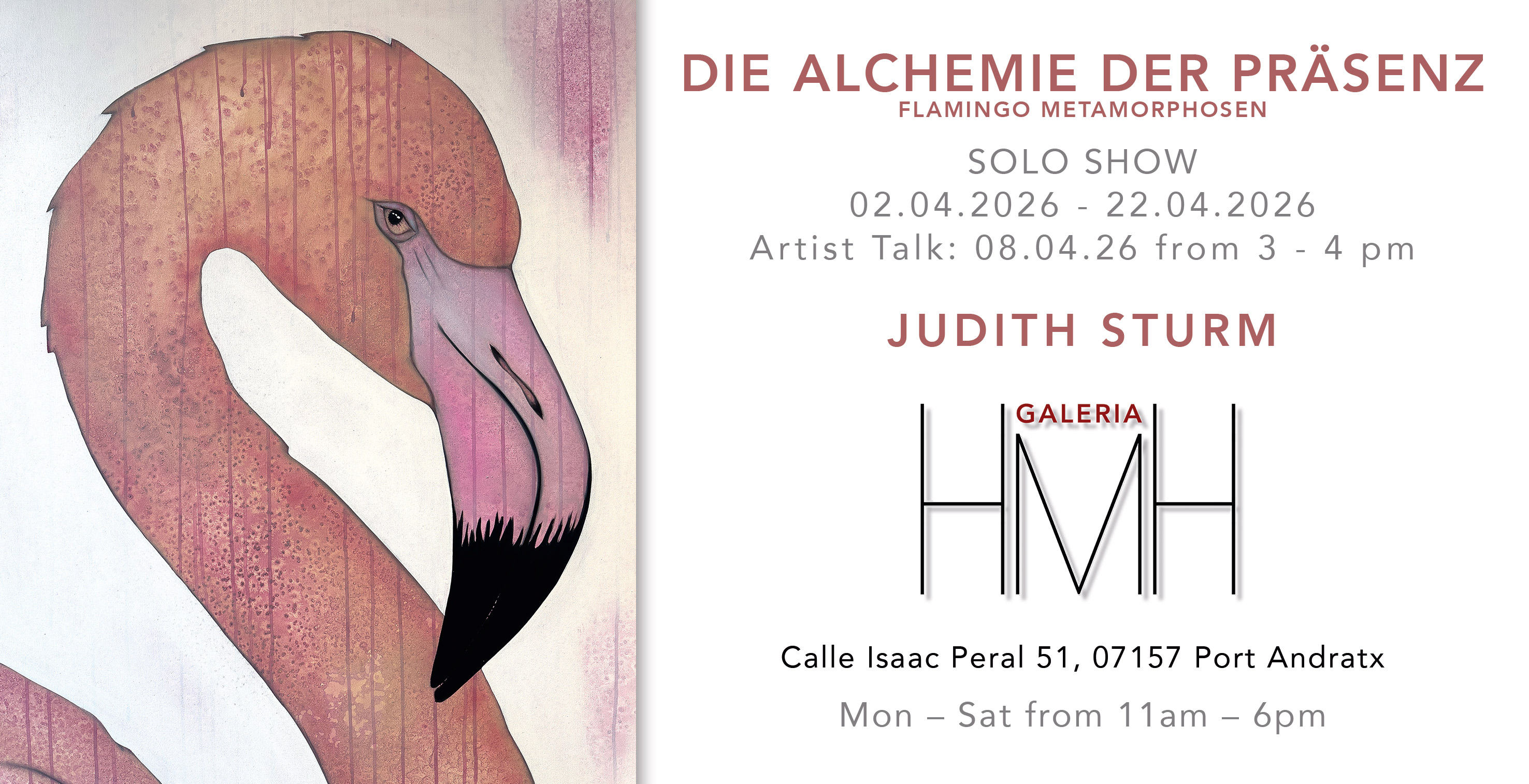
DIE ALCHEMIE DER PRÄSENZ
Solo show: Judith Sturm
Exhibition duration: 02.04.2026 - 22.04.2026
In her latest solo exhibition at Galeria HMH, Judith Sturm presents a body of work that re-explores the intersection of figurative representation and material abstraction. Under the title "The Alchemy of Presence," the flamingo—a classical motif of grace—becomes the subject of a profound metaphysical inquiry.
Sturm’s artistic practice is an inherent process of metamorphosis: through the deliberate integration of Mallorcan sea salt into her layers of pigment, she initiates chemical reactions that transcend mere visual depiction. This results in a haptic surface of organic intensity, translating the ephemerality of the moment into a lasting, physical presence.
Accompanying the exhibition is a catalogue of the same name, documenting the series’ oeuvre and featuring a profound art-historical analysis by Mag. Marion Fischer.
The Alchemy of Presence: Judith Sturm’s Flamingo Metamorphoses
An Art-Historical Classification Between Habitat and Individuation
In the contemporary painting of Judith Sturm, we encounter a remarkable re-contextualization of the flamingo motif that extends far beyond purely figurative representation. The characteristic features of these exotic animals—most notably the pink plumage, long legs, and elongated neck with a curved beak—are elements whose individual emphasis in certain of the artist's positions I will address briefly later. Sturm extracts the animal from its pop-cultural over-determination and transfers it into a sphere of material investigation. Central to understanding her work is the dialectic entanglement of subject and substance: through the integration of Mallorcan sea salt (Flor de Sal d’Es Trenc), the work becomes a physical depot of its own habitat.
I. The Origin: Material Archaeology (2017)
Judith Sturm’s artistic process began in 2017 as a form of material forensic investigation in the salt pans of Mallorca. In these early works, salt acts not as a mere additive but as a structure-forming agent. As seen in the works from 2017, the mineral crust creates an almost relief-like, corroded texture that transforms the background into an organic membrane. Here, the flamingo is still presented in its original color intensity, embedded in the raw, haptic reality of its place of origin—an artistic dialogue with the Genius Loci.
II. The Deconstruction of Color: Gentle Harry and the Satellites
In the period that followed, Sturm radicalized her approach through a conceptual breaking open of pictorial boundaries. The ensemble surrounding "Gentle Harry" marks a milestone in chromatic abstraction. Moving away from classic pink, cool blue and turquoise tones dominate here. The flanking, monochromatic "satellites" function as chromatic DNA: they isolate the primal color states of the main motif—the dense black of the beak tip, the deep blue of the neck—and charge them haptically. Here, the flamingo is no longer depicted merely as a biological being but is deconstructed into its energetic fragments.
III. Sense & Sensibility: The Metamorphosis into Skin (Present Day)
In her current phase of work, anthropomorphization (humanization) reaches a new, radical quality. A decisive feature of Sturm's technique is the conscious departure from depicting plumage. She does not paint feathers; she paints skin. This transfer of the incarnate—the classical representation of human skin tones—onto the animal body reaches its logical climax in the diptych "Sense & Sensibility":
- "Sense" appears as an almost human being of flesh and blood. Through the use of delicate skin and earth tones against a sand-beige background, the flamingo loses its exotic distance. It becomes the carrier of a vulnerable, intimate physicality.
- "Sensibility" mirrors this motif as an emotional antipode in vibrant pink against a warm peach backdrop.
This chromatic transposition is a masterly art-historical feat: the animal becomes a reflection of human existence. The boundary between the "other" of nature and the "self" blurs into a symbiotic unity of sand, salt, and pigment.
Conclusion
Judith Sturm’s flamingos are not portraits of birds, but metamorphoses of perception. In the oscillation between material density and chromatic lightness, she makes the fragility and dignity of the living tangible. Her art is an alchemical transformation of raw materials into a soulful presence, inviting the viewer to reflect on their own place in the world. Mag. Marion Fischer
Opening Hours
Mon - Sat: 11am – 6pm
Closed on Sundays